e-Day
e-Day is observed on February 7 to pay tribute to one of the most interesting constants of mathematics—Euler’s number.
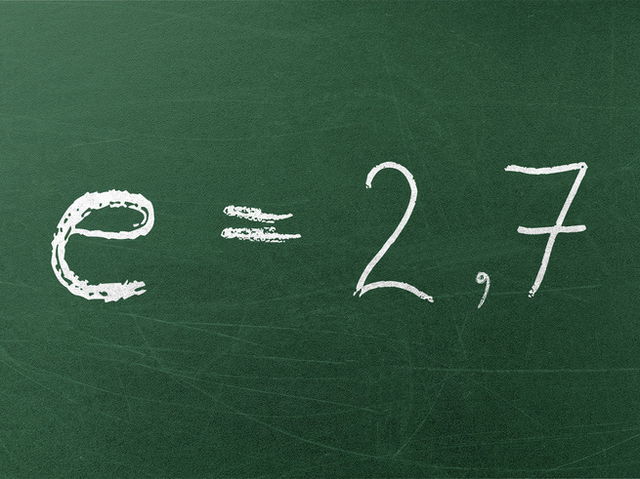
Euler's number is generally written as "e," and the approximate value is 2.71828.
This day unites mathematics fanatics and curious souls who love learning to express their gratitude to this simple yet powerful number.
e-Day is more than just textbooks and equations; it acknowledges the importance of mathematics in our day-to-day lives.
The roots of e-Day trace back to 2018, and credit goes to Ron Gordon, who was a high school math teacher and wanted to make mathematics less intimidating and playful.
Gordon picked the date 2/7 because it represents the first three digits of Euler's number 2.7.
History of Euler's number
Euler’s number first appeared indirectly in early logarithm tables in the 1600s, though no one recognized it as a special constant at the time.
In 1683, Jacob Bernoulli clearly identified it while studying continuous compound interest, showing it comes from the limit (1+1/n)n(1 + 1/n)^n(1+1/n)n.
In the 1720s, Leonhard Euler named the constant "e" and proved it could be written as an infinite series. His work made e famous and established it as a fundamental number in mathematics.
Significance of e
The constant e appears wherever growth or change is involved. It helps calculate:
- Compound interest in finance
- Population growth and decay
- Spread of diseases
- Radioactive decay
- Engineering and computer science models
How to observe e-Day
e-Day is observed in schools, colleges, homes, and online platforms through fun, interactive activities to make math feel like a breeze.
You can bake "e"-shaped treats or have the digits 2.718 inscribed on them. Host gatherings and invite your loved ones. Intrigue them with trivia and fun math activities, experiments, movies, puzzles, and so on.
e-Day is about making math more enjoyable and changing people's perception of it, as it encourages creativity, curiosity, and playful learning that proves math does not have to feel dull or boring.
Recommended Articles